
A Pakistani anti-terrorism court conducting the trial of seven suspects linked to the 2008 Mumbai attacks has adjourned proceedings till May 8, apparently in anticipation of an Indian court's verdict against Ajmal Kasab on May 3.

The sea training also included 'how to fish', something that made Kasab think that 'he had got a job and he could earn a respectable living'.
As investigations into the Mumbai terror attack are picking up pace, the links between the terrorists and Pakistan are becoming also becoming clearer. Ajmal Kasab, the only terrorist who was nabbed alive during the terror attack, has revealed that Pakistan authorities had deliberately turned a blind eye when he, along with his 10 associates, traveled to Mumbai.

Five years after his arrest during the 26/11 strike on Mumbai and over a year after he was hanged to death after a much-publicised trial, Lashkar-e-Tayiba terrorist Ajmal Kasab continues to inspire myriad conspiracy theories.

'He is the key to unravel the 26/11 conspiracy.'
The Federal Investigation Agency has decided to pursue a petition filed in the Lahore high court to challenge an anti-terrorism court's decision not to declare Kasab and Ansari as fugitives.
Several police inspectors went beyond their call of duty and stepped into the firing line to save others when terror struck the heart of Mumbai three years ago. Ganesh A Nadat meets some of them -- those who were hailed as heroes and those who were forgotten.
As the country observes the second anniversary of the 26/11 attacks, Union Law Minister M Veerappa Moily on Friday said the trial in the case was "fair" and completed in the "quickest possible time."
Shiv Sena chief Bal Thackeray said on Wednesday that he saluted the patriotic spirit of Muslim body Islam Gymkhana for deciding to terminate the services of Abbas Kazmi as its trustee for defending Mumbai attacks terrorist Ajmal Kasab.

Manish Malhotra's show, held at the Taj Mahal Palace in Mumbai, was a grand celebration of India's indomitable courage and its rich heritage and culture.
Hailing the conviction of Pakistani terrorist Ajmal Kasab for the Mumbai terror attacks, Special Prosecutor Ujjwal Nikam on Monday said the acquittal of two other accused in the case will be challenged in a higher court. "I am very happy (about the conviction of Kasab). But I regret the acquittal of two other accused Faheem Ansari and Sabauddin Ahmed. The court has given them the benefit of doubt. We will challenge their acquittal," Nikam said.
After weeks of denying the possibility, Pakistan turned around on its position -- admitting to CNN-IBN that some or all of the terrorists who carried out the 26th November attacks on Mumbai- could have been Pakistani nationals.
Investigation into the Mumbai terror attacks is making headway with the investigating agencies picking up more links to Pakistan.
Exclusive: Meet the Bigg Boss 4 contestants
Tukaram Omble was the biggest hero of 26/11. He was responsible for the capture of Ajmal Kasab, that helped confirm Pakistan's role in the attacks.
According to Lam, Waghmare had sought instructions from this witness and even signed a Vakalatnama to help him seek compensation. She had kept the court in dark about this development, Lam alleged. He contended that Waghmare cannot accept brief of accused Kasab if she had decided to appear for a witness in the same case.
A special court in Mumbai is expected to take a decision on Monday on a prosecution plea for postponement of the trial of three accused in the Mumbai attacks, including Mohammed Ajmal Kasab, to April 13.

"Why has Kasab been kept alive? He should not be shown any mercy and hanged without delay," says an angry Jamuna as she waits for justice to be done to her family five days from now when the anti-terror court is to pronounce its verdict in the 26/11 Mumbai terror attack case.
The ten terrorists who attacked Mumbai on November 26, kept in touch with their leader or minder through satellite phones, and acted as per his instructions. The minder had only one instruction for the terrorists -- kill as many people as possible. Ajmal Kasab, the lone surviving terrorist arrested in the Mumbai terror attack, has revealed that the minder of the Mumbai attacks was a man named Muzzamil, the second-in-command of the Lashkar-e-Tayiba.
Though the Mumbai police have sought for the custody of Sabahuddin first, Ansari's interrogation will be the key to the Mumbai terror attack case. While Sabahuddin played the role of a financer more than a plotter, Ansari is the man who did the recce in Mumbai and also prepared sketches of the locations that were attacked on 2/11/2008.

Riaz Akhtari and Ghouse Mohammad had fled after brutally hacking tailor Kanhaiya Lal to death in Udaipur on June 28.
The Shiv Sena in its mouthpiece Saamana, said that it was very sad that on Thursday, when the whole country was paying tributes to the martyrs of the serial attacks in Mumbai, the BCCI went ahead and declared the venue of the Indo-Pak bilateral series in December.
President Pranab Mukherjee has rejected the mercy plea of death row convict Saibanna Ningappa Natikar, who had murdered his wife and daughter.
Pakistani prosecutors on Saturday submitted documentary evidence provided by India, including confessional statement of Ajmal Kasab, in the anti-terrorism court conducting the trial of Lashkar-e-Tayiba's Zakiur Rehman Lakhvi and six others charged with involvement in Mumbai attacks, as a new judge began hearing the case.
Interrogation of terror accused Abu Jundal has so far revealed no new information that is not already in the public domain. Mystery surrounding several aspects of the Mumbai attack remain, reports Vicky Nanjappa.

Citing security reasons, the Maharashtra government on Wednesday opposed the plea of Zabiuddin Ansari alias Abu Jundal, alleged LeT operative, urging that he be removed from the solitary confinement of a cell in Arthur Road Central prison and be kept with other undertrials.
In India, the death penalty, as it is used now, is discriminatory. It's arbitrary and capricious nature renders it unconstitutional, says Justice A P Shah
Two days before the Hyderabad blasts, the Centre had alerted all states that Pakistan-based terrorist groups may carry out attacks in a major city to avenge the hanging of Ajmal Kasab and Afzal Guru.
A metropolitan court on Friday rejected the plea of a Pakistani judicial commission to cross-examine four key witnesses in the 26/11 Mumbai terror attacks case, saying it was not permissible.
Days after the execution of 2001 Parliament attack convict Afzal Guru, President Pranab Mukherjee rejected the mercy petitions of four associates of slain forest brigand Veerappan, who were given a death sentence in a landmine blast case.
In the competitive pre-poll attempt to show who is stronger in dealing with terrorism, the government and the Bharatiya Janata Party seem to have overlooked the mitigating factors and used Afzal Guru's execution as an unfortunate yardstick to establish their strong counter-terrorism credentials, says B Raman
Eminent public prosecutor Ujjwal Nikam, who was instrumental in sending Ajmal Kasab, the lone surviving militant of 2008 Mumbai attack to the gallows, has termed David Headley's sentence as meagre in comparison to the brutality and heinousness of the crime.

Uttam Ghosh offer his take on the Pragya Thakur controversy.
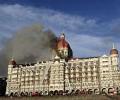
A four-member team of Indian legal experts has arrived in Pakistan to finalise the terms of reference of a judicial commission that is expected to visit India next year to gather evidence on the 2008 Mumbai attacks.
Floral tributes were paid to martyrs of the 2008 Mumbai terror attacks on the fourth anniversary of the strike on Monday with Union ministers Sushil Kumar Shinde and Sharad Pawar laying wreaths at the police memorial in South Mumbai.
'People of Pakistan abhor violence, they have seen so much. They did not and do not support the 26/11 terror attacks on Mumbai,' B M Kutty, a Pakistani activist from Kerala, tells Athimuthu Ganesh Nadar in an exclusive interview.
'How can we know why so many officers went there unprepared and got killed? Why was there was an absence of coordination and cooperation from the Mumbai police control room?' asks Kavita Karkare, slain Anti-Terror Squad chief Hemant Karkare's widow.
With friends who are now turning away rather than recognise them on the street, Pakistan is also trying to prepare itself for inevitable domestic leadership changes, says Aditi Phadnis
Lashkar founder Mohammad Sayeed and 26/11 attacks accused Zaki-ur Rehman Lakhvi must be neutralised one by one if Pakistan does not act against them, says Brigadier Gurmeet Kanwal (retd).

The Mumbai police on Tuesday filed a supplementary chargesheet in the 26/11 terror attack case naming Lashkar-e-Tayiba operative Zabiuddin Ansari alias Abu Jundal as one of the key conspirators.
